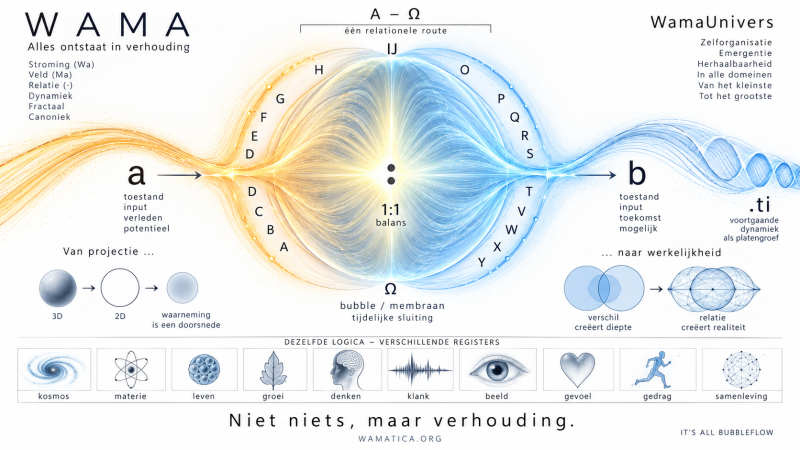
Language as a Function Becomes Language as a Driver
I wanted it to be able to perceive fractal patterns properly and efficiently: .end curves that can be played back or exchanged in a .ti stream. I figured that if everything works in the same fractal way, language should work that way too. Sound produces pressure, with dynamics that might also be canonical. After all, phonetics arises from physical movements that express a state.
My experience as a co-developer of the KWeC methodology, kwec.nl, now came in handy. Developed by Carine Manderfeld for multisensory spelling education, the method is based on listening, acting on what you perceive, and applying spelling rules. Sound alone can already carry a great deal of information for writing and spelling language correctly. What you need is not just words, but above all context.
I analyzed how tension is transferred during speech. I found that the place where you build a sound — in your throat, mouth and lips — could be related to intentions and movements.
What struck me was that capital letters, seen as letter logos, look suspiciously similar to the movements of the verbs I had distilled from the meaning of their sounds. A turned on its side as a mouth; G as a cavity with an arrow pointing inward, opening toward the next letter; I as a vocal cord standing for “I”; N and Z as tilting symbols. E (𝛴), W and M are tilted as well. H (8), O and Q (φ) appear as closed units. C (Γ), L and V act as extenders.
And the sequence also matched the sequence of the routines.
The Alphabet as Process Characters
I delved into the history of writing and found that, in a sense, the logos had not changed all that much since the Egyptians, from whom our alphabet ultimately came through the Phoenicians and Greeks. The Phoenicians also used their 22 characters as numerals. The Greeks changed relatively little, but rearranged some letters and added Upsilon and Omega.
What caught my attention in these logos was their form — something more than the abstraction we are accustomed to reading. A was called an ox head because the signs were assumed to depict things. R was represented as a head or profile in older scripts. Γ, Gamma, developed differently in later alphabets, while Z and G also acquired different positions and forms as the alphabet evolved.
It would take us too far to treat every letter this way, but I increasingly noticed that the verbs I had attributed to the letters showed similarities to what the logos themselves appeared to represent — and, in that sequence, seemed to depict a process.
That became a testable hypothesis for me: perhaps a letter is not merely an abstract symbol for a sound, but its shape, sound and position in the sequence also carry relational information.
>-𝛢𝛣𝛤𝛥 𝛦 𝛧𝛨𝛩𝛪->- 𝛫𝛬𝛭𝛮 𝛯𝛰𝛱 𝛲𝛳𝛴 𝛵𝛶𝛷 𝛸 𝛹𝛺
>-ABCD E FGHIJ ->- KLMN O PQRS ->- TUVW X Y Z
The routines that are sufficient for the kernel to calculate complex stages relationally turned out to fit remarkably well along this alphabetical route. Too crazy for words, I thought.
Names from antiquity as well as today can be read as routes when you place the verbs I had attributed to the letters alongside them. Whether this really applies universally will have to be demonstrated through application, but it gave me a practical starting point for no longer treating sound as an isolated symbol.
After all, vowels and consonants convey more information than words alone. Animals do the same through pitch, rhythm, volume, duration and direction.
A computer that knows what tension pattern belongs to a particular piece of the “record groove” can reconstruct meaning from sound, syllable, direction and context without necessarily knowing every word beforehand.
With this knowledge I could generate syllables as operators for a computer. The aim is to enable it to read, listen to and speak languages without depending primarily on a dictionary, because sounds are canonically encoded in sectors and registers.
And this need not be limited to human language. All sounds, including those made by animals, can be treated in the same way we experience them: as changes in tension and direction.
Sound, Image, Feeling, Behavior and All Other Forces Follow the Same Logic
From a:b follows A:B, B:C, C:D all the way to Y:Ω — and back again — provided that the spatial relationship is taken into account.
Sound and image can now be built as harmonies within the same sectors of registers. An image appears, disappears, grows, shrinks, moves and changes color. It follows the same pattern as sound in another register, while remaining in the same sector in terms of proportions and feeling.
So enlargement, turning red, a heavy or “large” sound and a corresponding movement can all end up in the same dynamic sector without requiring the same sensor. A movement in response can therefore be fed back multisensorially. The same applies to the behavior and sounds of a human, animal or plant.
Whether the principle works must ultimately be demonstrated by what emerges from the kernel. The kernel itself does not need to know what a molecule, cell, skin, animal or plant is. It does nothing more than pass on a:b as a relational state.
You can, for example, read the route biologically. Base fractal A balances with incoming fractal B, creating new dynamics. Further couplings can allow space, closure, membrane formation, vortices, attachment and movement to emerge. In a biological application, stages may then be recognized that resemble molecule formation, cell formation, skin, attachment or organs of movement.
But those meanings are not pre-programmed into the kernel as H, IJ, S, T, L or W. The letter indicates the position and dynamics within the route. Its biological meaning emerges from the state in which that route is being used.
That is precisely why the same A–Ω route remains available for something entirely different from biology.
Nor does this necessarily happen gradually. Transitions between registers are jumps. Like the musical notes do-re-mi. The final do is the transition into the next register.
Sensory input is first made canonical before it is processed by the kernel. The kernel does not need to know whether the input is image, sound, pressure or movement. That meaning remains outside the kernel.
Whatever enters is reduced to relational balance values a:b within the applicable unit and route. The selected A through Ω routines run through WamaGenome.c until the requested state or limit has been reached.
The result can be exported as Bézier curves in the .ti format. If this produces a reusable routine, it is stored as an .end solution capable of carrying partial dynamics within a larger context.
Using .ti, the required balance variables can then be translated into image, sound or control signals for devices such as drones and robots. These .end patterns are retained and therefore only need to be transferred once. From then on, they form a box of building blocks that only needs to do, in the correct sequence, what the .ti balances trigger.
Add comment
Comments